An above ground water storage tank is one of the most practical investments a homeowner can make — whether you're on city water and want emergency backup, on a private well and worried about pump failure, building off-grid, or simply storing water for irrigation and livestock. This guide covers every residential option: what types exist, what size you actually need, what they cost, and what to look for before buying.
| Best material | Food-grade HDPE poly (black or dark green for outdoor, white for indoor) |
| Common home sizes | 100, 150, 200, 250, 500, 1,000 gallons |
| Emergency storage (family of 4) | 100–200 gallons (2-week supply) |
| Well backup recommended | 500–1,000 gallons (2–5 day buffer) |
| Off-grid primary storage | 1,000–2,500+ gallons |
| Typical cost range | $350–$3,000 depending on size |
| Best brand | Norwesco, Snyder (both US-made, UV-stabilized, food-grade) |
| Installation | Level concrete or compacted gravel pad required |
The Two Numbers That Decide This Project
Before choosing a tank size or material, two numbers determine almost everything else about a home water tank system.
Pressure: 0.433 PSI Per Foot of Elevation
The mental picture of a home water tank is a water tower — put the tank up high and gravity handles the rest. The arithmetic says otherwise.
| Elevation | Gravity Pressure | Adequate for |
|---|---|---|
| 5 ft | 2.2 PSI | Drip irrigation only |
| 10 ft | 4.3 PSI | Garden hose (slow), filling buckets |
| 20 ft | 8.7 PSI | Drip irrigation, trough filling |
| 50 ft | 21.7 PSI | Marginal for some outdoor uses |
| 92 ft | 40 PSI | Minimum for household fixtures |
| Typical house supply pressure: 40–60 PSI. Formula: PSI = elevation (ft) × 0.433 | ||
The practical answer: Nearly every home tank system needs a pump — a booster pump with a pressure tank, or an on-demand pump — to deliver usable household pressure. Budget for it from the start. Gravity works well for drip irrigation, filling livestock troughs, and garden hose use at low flow. It does not run a house.
Weight: 8.34 Pounds Per Gallon
A 2,500-gallon tank is a common residential size. Full, it holds 20,850 pounds — about ten tons. That load sits on a circle roughly eight feet across. It is a concentrated point load on whatever is underneath — which is why an improvised base fails.
| Tank Size | Water Weight | Foundation Implication |
|---|---|---|
| 500 gal | 4,170 lb (~2 tons) | Compacted gravel or concrete pad |
| 1,000 gal | 8,340 lb (~4 tons) | Concrete slab recommended |
| 2,500 gal | 20,850 lb (~10 tons) | Engineered concrete slab required |
| 5,000 gal | 41,700 lb (~21 tons) | Engineered foundation, possible crane delivery |
| 10,000 gal | 83,400 lb (~42 tons) | Professional engineering required |
| Plus tank dry weight. Settling gravel, soft ground after rain, a wooden deck, or uncompacted fill will fail under these loads. | ||
Why Homeowners Install Above Ground Water Tanks
The reasons vary but the common thread is reliability — having water supply that doesn't depend on a utility company, a well pump, or normal infrastructure. The four most common residential use cases:
| Use Case | What It Solves | Recommended Size |
|---|---|---|
| Emergency preparedness | Power outages, natural disasters, water main disruptions | 100–200 gallons |
| Well pump backup | Pump failures, pressure tank problems, drought drawdown | 500–1,000 gallons |
| Off-grid primary storage | No municipal connection, rain catchment supplement, water delivery storage | 1,000–2,500 gallons |
| Irrigation & livestock | Garden, greenhouse, small-scale animal watering | 250–1,000 gallons |
Types of Above Ground Water Tanks for Home
Standard Vertical Poly Tanks (Outdoor)
The most common residential choice — round cylindrical tanks in black, dark green, or white HDPE. Black and dark green are the standard for outdoor potable water storage: the dark color blocks UV light and prevents algae growth inside the tank. These tanks sit on a flat level pad (concrete or compacted gravel) and connect to your plumbing through the bottom outlet.
Norwesco and Snyder are the two dominant US manufacturers. Both use FDA-compliant virgin polyethylene rated for potable water storage. Available from local farm supply stores, irrigation dealers, and online through eBay and Amazon. See our complete Norwesco tank guide for sizes, prices, and part numbers across the full product line.
| Size | Best For | Approx. Cost | Size Guide |
|---|---|---|---|
| 100 gallon | Emergency prep (family of 2–4), supplement storage | $350–$400 | 100-gal guide → |
| 150 gallon | Emergency prep (family of 4–6), small livestock | $450–$500 | 150-gal guide → |
| 200 gallon | Family of 4–6, 30-day emergency buffer | $500–$560 | 200-gal guide → |
| 250 gallon | Well backup starter, horses, larger family emergency | $580–$650 | 250-gal guide → |
| 300 gallon | Well backup, small farm water, irrigation supply | $650–$700 | 300-gal guide → |
| 500 gallon | Well backup (2–3 days), off-grid supplement, irrigation | $900–$1,000 | 500-gal guide → |
| 1,000 gallon | Off-grid primary, well backup (4–5 days), small cattle operation | $1,400–$1,800 | 1,000-gal guide → |
| 2,500 gallon | Off-grid primary, water delivery storage, larger operations | $2,500–$3,200 | 2,500-gal guide → |
Doorway / Slimline Tanks (Indoor)
Narrow-profile tanks designed to fit through a standard 32-inch doorframe — the practical solution for garage, basement, or utility room installation where a standard round tank won't fit. These stand upright without framing, typically 28–30 inches wide, and are available in white food-grade HDPE. Norwesco's 400-gallon doorway tank (part# 43856) is the most searched model — 29 inches wide, 70 inches tall. See our doorway tank section for the full size range and pricing.
Slim Vertical Tanks
A subset of vertical poly tanks with a narrower diameter relative to height — designed for tight spaces where a standard round tank's footprint is too wide. Norwesco makes several slim-profile models. The 65-gallon low-profile horizontal tank and slim vertical options fit along walls, under decks, or in utility corridors. Useful for supplemental storage where a standard tank's footprint won't work.
Bladder Tanks (Flexible Collapsible Storage)
Flexible pillow-shaped tanks that store flat when empty — useful for emergency preparedness where permanent installation isn't practical. See our bladder tank guide for collapsible storage options that don't require a permanent pad or installation.
How to Size a Home Water Reservoir Tank
Two numbers determine your tank size: daily household consumption and how many days of backup you need. Use these benchmarks:
| Scenario | Daily Usage | Buffer Target | Tank Size |
|---|---|---|---|
| Emergency drinking water only (family of 4) | 8 gal (2 gal/person) | 14 days | 100–150 gallons |
| Emergency full household (family of 4) | 200 gal | 3 days | 500–750 gallons |
| Well pump failure backup (family of 4) | 200 gal | 5–7 days | 1,000 gallons |
| Off-grid primary (family of 4, conservation) | 100 gal | 14 days | 1,000–1,500 gallons |
| Off-grid primary (family of 4, normal) | 200 gal | 14 days | 2,500 gallons |
For a more precise calculation, use our water storage calculator — enter your household size, usage level, and buffer duration and it recommends the right size with a direct link to the size guide. Use the water weight calculator before installation to confirm your pad and floor can support the full tank weight.
Material Comparison: Poly, Fiberglass, and Steel
| Material | Typical Residential Range | Corrosion | Foundation Demand | Best For |
|---|---|---|---|---|
| Polyethylene (HDPE/XLPE) | 250 to 10,000+ gal | None | Lowest — smaller tanks often don't need concrete | Most residential uses. Dominates retail because it hits the sweet spot between cost and reliability. |
| Fiberglass | 560 to 60,000 gal | None | Moderate — flat foundation | Coastal/salt air environments. Durability without heavy foundations. |
| Corrugated Steel | 5,000 to 100,000 gal | Requires liner and coating management | Heaviest | Large capacity, fire suppression, agricultural. Modular assembly on site. |
| Concrete cistern | Varies | None | On-site construction | Extremely durable but rarely installed new due to cost. Common on older properties. |
The guiding rule as size grows: as gallon targets rise, shift toward engineered metal systems. Fiberglass earns its premium specifically in salt air environments and sites where heavy foundation work is a drawback. For a house in most climates, polyethylene is the right starting point.
Potable Water Certification — NSF/ANSI 61 and 372
| Certification | What It Covers |
|---|---|
| NSF/ANSI 61 | Health effects of all contaminants leaching into water from materials in contact with it |
| NSF/ANSI 372 | Lead-free compliance specifically |
For fiberglass specifically, the resin matters: vinyl ester resin is used for potable water and NSF 61 applications. Orthophthalic resin is for general purpose and greywater; isophthalic for enhanced corrosion resistance and chemical service.
Fittings You Need — and Two You Cannot Skip
| Fitting | Purpose | Notes |
|---|---|---|
| Inlet | Where water arrives | On automatic fill, a float valve controls level — see our float valve guide |
| Outlet | Where water leaves to pump or fixtures | Position above the tank floor so sediment is not drawn in |
| Overflow | Safety discharge when tank is full | Size at least as large as the inlet. Route away from the tank base — overflow discharging at the foundation erodes it. |
| Vent | Allows air to enter as water leaves | Structural, not optional. A sealed tank collapses inward when pumped down. Screen the vent on potable tanks. |
| Drain | Cleaning and winterizing | At the lowest point |
| Manway / access hatch | Inspection and cleaning | Must seal properly |
| Level indicator | Track volume without guessing | Sight tube, float gauge, or electronic |
Installation Basics
Above ground poly tanks are straightforward to install compared to underground cisterns, but a few requirements apply regardless of tank size:
- Level pad required. All vertical poly tanks require a flat, level base — concrete slab or compacted gravel (minimum 4 inches compacted) with a stable base. An unlevel tank stresses the base fitting and can crack the outlet over time. Large tanks (500+ gallons) should sit on a concrete pad reinforced to handle the full load.
- Shade or UV exposure. Black and dark green tanks handle direct UV well — they're designed for outdoor use. White tanks are for indoor or shaded installations and will degrade faster with prolonged direct sunlight.
- Overflow planning. Every tank should have an overflow pipe that directs overflow water away from the foundation. Without a dedicated overflow, a refill mistake or rain catchment surge can flood the area around the tank base.
- Inlet and outlet plumbing. The top bung accepts a standard fill connection; the bottom outlet (2" NPT or BSP depending on model) connects to your distribution piping. For gravity-feed systems, the tank must be elevated or positioned above the point of use. For pressure delivery, a booster pump on the outlet line is required.
- First fill and sanitization. For potable water storage, rinse the new tank with a dilute bleach solution (1 tablespoon unscented bleach per gallon of water, let sit 30 minutes, drain and rinse) before filling with drinking water for the first time.
Freeze Protection
The tank body itself — with its large thermal mass — rarely freezes solid in a normal winter. Surface ice is common. The fittings are where failures happen — small-diameter pipe, valves, and exposed connections freeze long before the tank does. The outlet line between tank and pump is the classic failure point.
| Mitigation | How |
|---|---|
| Bury the lines | Below frost depth wherever possible |
| Heat trace and insulate | Exposed pipe, valves, and fittings |
| Keep it fuller | More thermal mass, slower to freeze |
| Check the vent | A blocked vent plus a running pump collapses the tank |
| Drain for seasonal properties | The reliable answer for a cabin — drain the tank and all lines |
Where to Buy an Above Ground Home Water Tank
Local farm supply stores — TSC, Rural King, local agricultural co-ops, and irrigation suppliers typically stock the 100 to 550-gallon range and can special-order larger sizes. Buying locally eliminates freight costs ($150–$400 for most sizes shipped) and lets you inspect before accepting. Call ahead to confirm stock before making the trip.
For indoor emergency storage specifically, WaterPrepared makes purpose-built tanks in 35, 55, and 160-gallon sizes — stackable, doorframe-compatible, and sold on Amazon. Their 160-gallon is the only tank at that capacity designed to fit through a standard 32-inch interior door without tools or equipment.
eBay — The widest selection of Norwesco and Snyder tanks online, including uncommon sizes and elliptical/leg tank variants. Freight shipping available nationwide. Current pricing and availability across all sizes in our Norwesco buyer's guide.
US Water Systems — For premium atmospheric tanks in the 500–1,500 gallon range with NSF certification and direct shipping. Higher price point but higher specification for potable water applications. See our 1,000-gallon guide for USWS tank details.
Find Your Size
Top Picks: Elkhart Plastics Vertical Water Storage Tanks
Elkhart Plastics is one of the few brands selling large-capacity rotationally molded poly tanks directly on Amazon with real product images, real ASINs, and freight-eligible shipping. All three models below are NSF/FDA certified for potable water, UV-resistant HDPE, and include dual manway risers and molded gallon markers. Available in 1,000, 1,500, and 2,500-gallon sizes.
⚠️ Delivery note: These ship by freight truck. Inspect the unit immediately on arrival — some buyers report missing parts or damaged components. Document any issues before signing and source fittings separately as manufacturer support is limited.
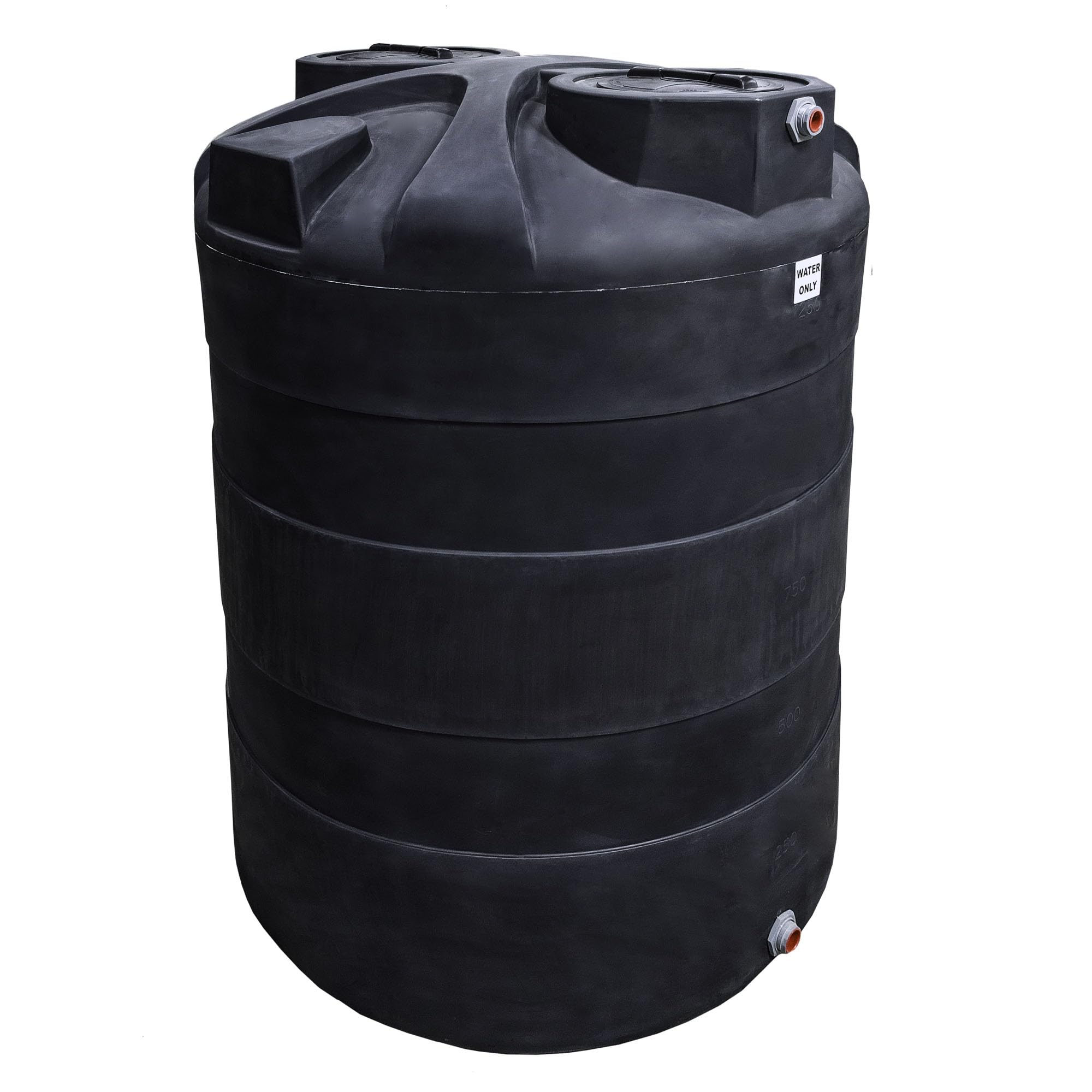
The mid-range pick — large enough for serious rainwater collection, well backup, or emergency storage for a family, yet manageable on a standard compacted-gravel pad. At 94 inches square it fits most residential lots. Dual manways make cleaning and inspection practical. Best for homeowners who want the balance of capacity and footprint.
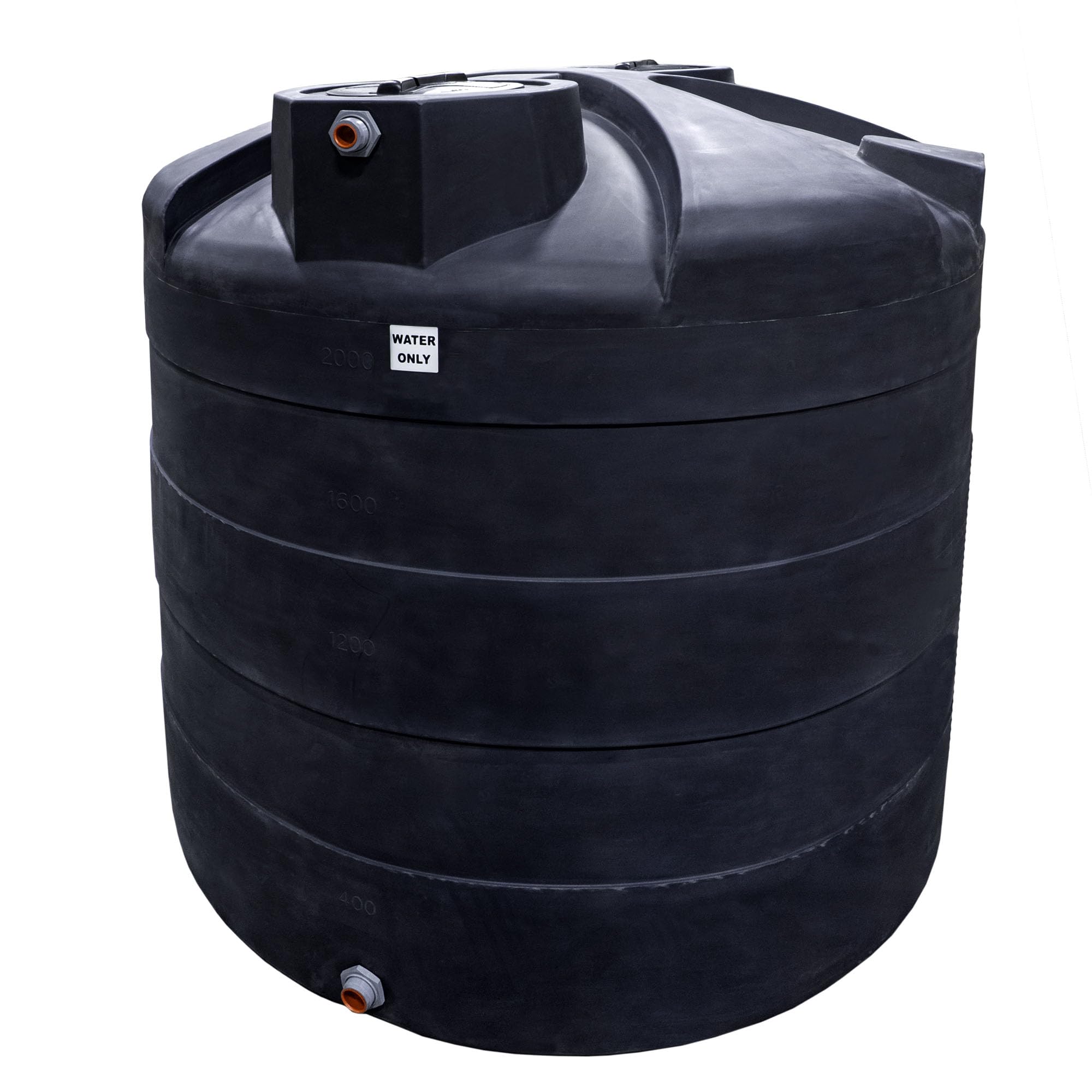
The highest-capacity option in the Elkhart lineup. At 2,500 gallons, a full tank weighs nearly 10.5 tons — an engineered concrete pad is required. Best for agricultural irrigation, rural off-grid properties, or homesteads that want meaningful long-term water independence. Reduces municipal water dependence for irrigation significantly.
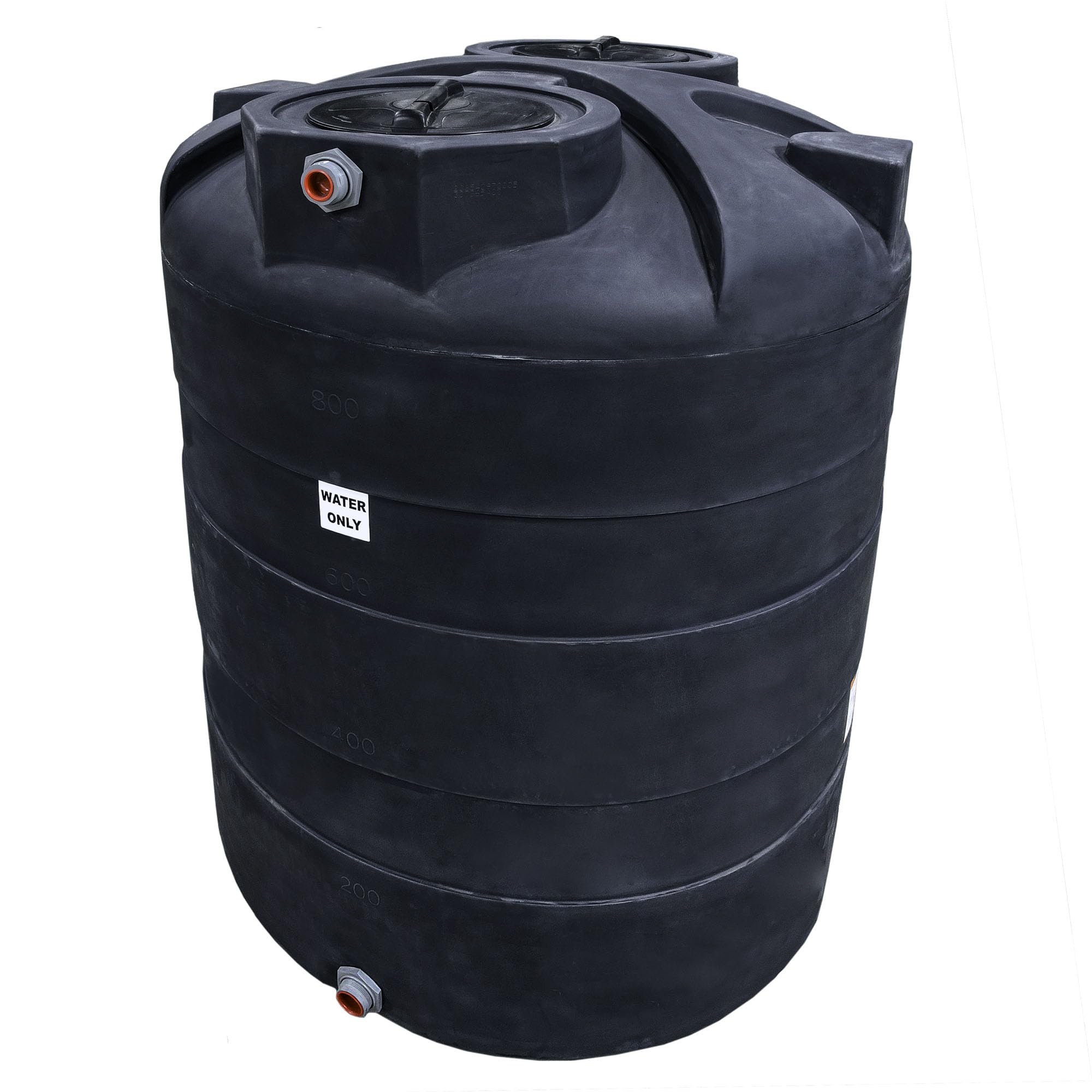
The compact option — 79 inches square and 158 lbs empty, fits on a compacted gravel pad in most yards. At 1,000 gallons it covers 60–90 days of drinking water for a family of four (using FEMA's 1 gallon/person/day guideline), or several weeks of full household use. Good entry point for rainwater harvesting or well backup without the footprint demands of larger tanks.
| Model | Capacity | Footprint | Empty Weight | Full Weight | Certified |
|---|---|---|---|---|---|
| Elkhart 1,000 gal | 1,000 gal | 79" × 64" | 158 lbs | ~8,500 lbs | NSF/FDA |
| Elkhart 1,500 gal | 1,500 gal | 94" × 72" | 206 lbs | ~12,700 lbs | NSF/FDA |
| Elkhart 2,500 gal | 2,500 gal | N/A | 336 lbs | ~20,900 lbs | NSF/FDA |
| Full weight calculated at 8.345 lbs/gallon + empty tank weight. All tanks require a level, compacted base. 2,500 gal requires engineered concrete pad. | |||||
Sievers Poly Tanks, "How to Choose a Water Storage Tank (2026)" · SC Well Service, "Buried vs Above Ground Water Tanks: Complete Comparison Guide (2026)" · Ironclad Environmental Solutions, "Choosing the Right Aboveground Water Storage Tanks" · Tank Depot fiberglass and potable water tank documentation · NSF/ANSI 61 and NSF/ANSI 372 standards · Physical constants: water density 8.34 lb/US gal; hydrostatic pressure 0.433 PSI per foot; rainwater conversion 0.623 gal/sq ft/inch
Frequently Asked Questions
For most homeowners, a black or dark green Norwesco or Snyder vertical poly tank is the best option. Poly tanks are food-grade safe, UV-stabilized, corrosion-free, and available in sizes from 100 to 10,000 gallons. The 250 to 500-gallon range covers most emergency storage and well backup applications. For indoor installation, a doorway tank is the practical choice.
Poly water tanks for home use typically cost $350–$960 for common residential sizes. A 100-gallon tank runs $350–$400, a 250-gallon runs $550–$650, and a 500-gallon runs $900–$1,000. Freight shipping adds $150–$400 — buying local eliminates this cost entirely.
Yes — doorway tanks are specifically designed for indoor installation. These narrow-profile tanks (under 30" wide) fit through a standard 32-inch doorframe and stand upright in garages, basements, and utility rooms. For concrete slab floors, tanks up to 500 gallons are generally fine. For wood-framed floors, verify load capacity — a full 500-gallon tank exceeds 4,000 lbs.
Most municipalities don't require permits for above-ground poly tanks under 1,000 gallons used for non-potable storage. Tanks connected to your home's potable water plumbing may require a plumbing permit. Rainwater harvesting tanks are subject to state-specific laws. Check with your local building department before installing any tank over 500 gallons or any tank tied into home plumbing.
At FEMA's recommended 2 gallons per person per day for a 14-day supply: a family of 2 needs 56 gallons, a family of 4 needs 112 gallons, a family of 6 needs 168 gallons. A 100-gallon tank covers a family of 4 at minimum; a 150 or 200-gallon tank provides a comfortable 2-week buffer. Use our storage calculator for a precise recommendation.
For well pump backup, a 500 to 1,000-gallon black poly vertical tank is the standard recommendation. At average residential consumption of 50 gallons per person per day, a family of 4 uses 200 gallons per day — a 1,000-gallon tank provides 5 days of backup. The tank should be installed with a gravity-feed outlet or booster pump to maintain household water pressure during pump failure.

Water and wastewater treatment professional with 18+ years of hands-on experience in municipal and industrial water systems. He founded TankAuthority to bring operator-level knowledge to water storage decisions for homeowners, farmers, and contractors.