
What Is a Portable RV Holding Tank?
A portable RV holding tank — also called a tote tank, honey wagon, or waste tote — is a wheeled, sealed container that connects to your RV's sewer outlet to transfer waste to a dump station when your rig can't reach the station directly. They're an essential tool for dry camping, boondocking, or parking in campsites without sewer hookups.
They connect to your RV's black or gray tank using a standard 3" bayonet sewer fitting and hose. Once full, you wheel or pull them to the nearest dump station, empty them, rinse, and return. The best ones handle this process without spills, backbreaking effort, or dramatic odor events.
Who Needs a Portable Holding Tank?
- Boondockers and dry campers: The primary use case. When you're parked far from a dump station and don't want to break camp every 2–3 days, a portable tank extends your stay significantly.
- RVers at sites without sewer hookups: Electric/water-only sites are common at state parks and many private campgrounds. A portable tank lets you stay at these sites without managing dump station logistics daily.
- Anyone whose RV sewer hose can't reach the dump station: Even at full-hookup sites, the sewer connection is sometimes on the wrong side or too far away. A tote tank bridges the gap.
- Seasonal storage situations: If your RV sits in a driveway or storage lot near a sewer cleanout, a portable tank makes emptying convenient without moving the rig.
What Size Do You Need?
| Tank Size | Full Weight | Best For | Trips to Dump Station |
|---|---|---|---|
| 15 gallon | ~125 lbs full | Solo travelers, Class B vans, cassette toilet backup | Every 1–2 days for 2 people |
| 21 gallon | ~175 lbs full | Couples, weekend campers, first-time tote buyers | Every 2–3 days for 2 people |
| 27 gallon | ~225 lbs full | Families, frequent dry campers, travel trailers | Every 3–5 days for a family of 4 |
| 32 gallon | ~267 lbs full | Extended stays, larger rigs, high-use households | Every 5–7 days for a family of 4 |
| 42 gallon | ~350 lbs full | Extended boondocking, large Class A tanks | Weekly for a family of 4 |
| Weights based on 8.345 lbs/gallon. Full tanks require two people or a pump-out hose for safe transport. Four-wheel models (Thetford SmartTote 2) are significantly easier to maneuver when full. | |||
Best Compact: Camco Rhino — 15 Gallon

The Camco Rhino is the pick when compact footprint and storage ease matter most — at 20.5 × 20.5 inches it fits compartments where larger totes won't. The no-flat wheels are durable enough for gravel and grass, and the removable steel tow adapter gives you roll-or-pull flexibility. Includes the sewer hose and fittings so you're set up at the dump station without a parts run. At 125 lbs full it's manageable solo on flat terrain, which is the right scale for van campers and solo travelers.
- Compact footprint — fits tight storage compartments
- No-flat wheels; no flat tire risk on rough sites
- Removable tow adapter for roll or tow use
- Includes sewer hose and fittings
- Solo-manageable at full weight (~125 lbs)
- No capacity indicator — can't tell fill level without guessing
- 15 gallons requires frequent dump trips for couples or families
Best with Indicator: RecPro — 36 Gallon

The RecPro 36 is the pick when you want to know how full the tank is without guessing — the capacity indicator removes the uncertainty that catches people off guard at the wrong moment. Rotational front wheels make one-person steering manageable, the airless tires need no maintenance, and the included ladder hanger and gloves cover the practical bases at the dump station. At 36 gallons it's large enough for multi-day family trips while still being towable by one person on flat to moderate terrain.
- Capacity indicator — know when to dump before it becomes a problem
- Airless tires — zero flat tire maintenance
- Rotational front wheels for one-person steering
- Ladder hanger and gloves included
- 36 gallons handles multi-day family use
- ~300 lbs full — two people on rough or uphill terrain
- Large footprint (44.5" long) — verify storage bay dimensions before buying
Best Towable: Venustank — 30 Gallon
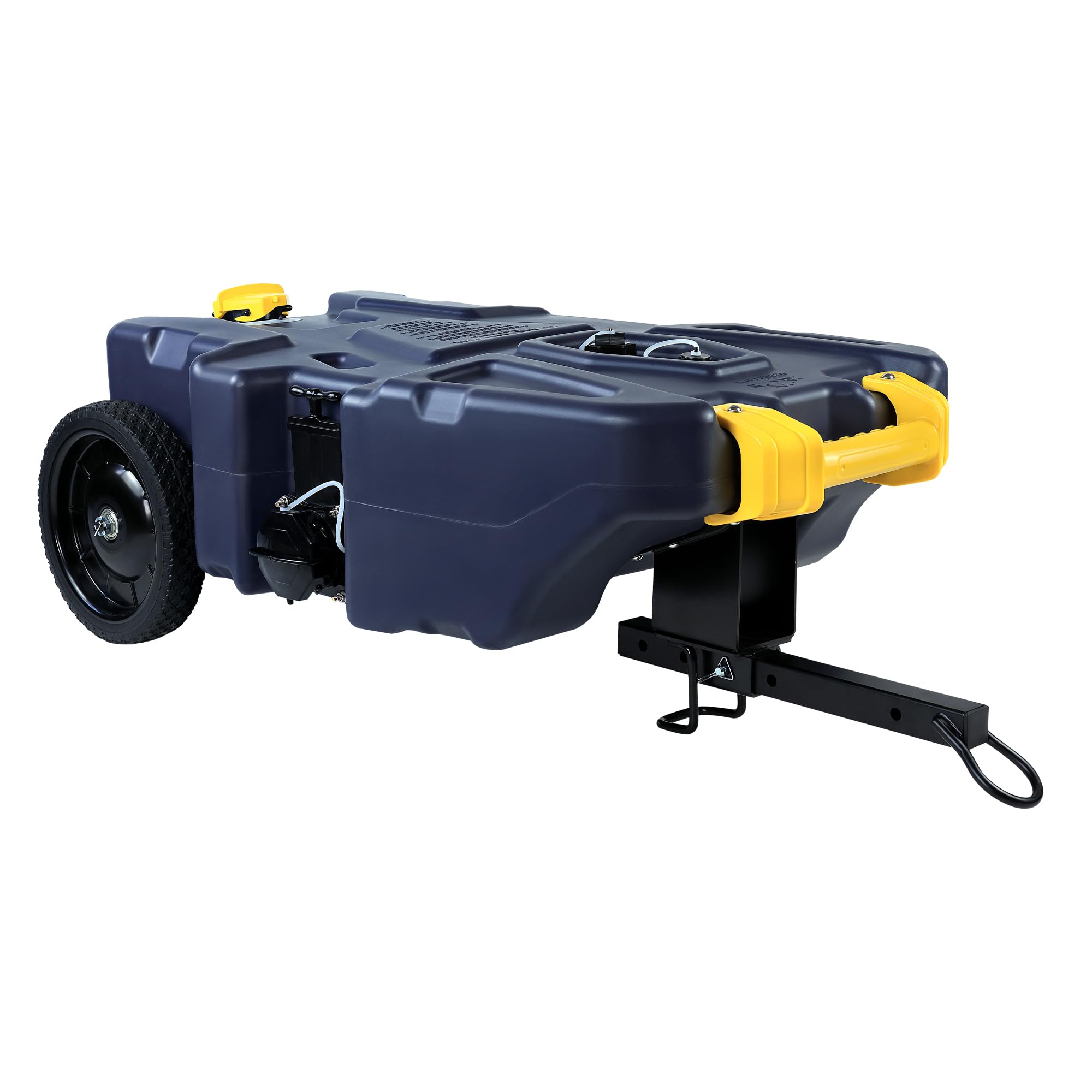
The Venustank 30 is built for the job when you need to tow the tank behind a golf cart or vehicle rather than push it. The tow bar attachment and large solid-rubber rear wheels handle gravel and rough campground terrain without the flat tire risk that plagues pneumatic-tired totes on debris-heavy sites. At 30 gallons it covers multi-day use for a couple or short stays for a small family, and the included hose means you're dump-ready out of the box.
- Tow bar for pull-behind-vehicle use
- Solid rubber wheels — no flat tire risk on rough terrain
- Durable polyethylene construction
- Includes sewer hose and fittings
- No capacity indicator
- ~250 lbs full — requires tow vehicle or cart on rough sites
Best High-Capacity: Barker 4-Wheeler — 42 Gallon

For extended boondocking and families who want to minimize dump station trips, the Barker 4-Wheeler is the maximum practical capacity in a portable tote. At 42 gallons a family of four can realistically go 7–10 days depending on water use habits. The tow-on-ground design eliminates lifting for dumping, pneumatic tires handle gravel well, and front-swivel wheels make positioning a ~350-lb loaded tank possible for one person on flat terrain. Ships fully assembled with the 5' sewer hose — ready to use on arrival.
- 42 gallons — maximum capacity for minimum dump trips
- 4-wheel design; front-swivel for maneuvering
- Tow-on-ground — no lifting required to dump
- Ships fully assembled with hose and fittings
- Pneumatic tires handle gravel campsites well
- ~350 lbs full — two people on rough or uphill terrain
- Large footprint (45" long) — verify storage bay fits before buying
- Pneumatic tires can go flat; check pressure before each use
Comparison Table
| Product | Capacity | Wheels | Full Weight | Indicator | Best For |
|---|---|---|---|---|---|
| Camco Rhino | 15 gal | 2-wheel, no-flat | ~125 lbs | No | Solo, vans, tight storage |
| RecPro 36 | 36 gal | 4-wheel, airless | ~300 lbs | Yes | Families; fill level visibility |
| Venustank 30 | 30 gal | Rear solid-rubber + tow bar | ~250 lbs | No | Towing behind vehicle or cart |
| Barker 4-Wheeler | 42 gal | 4-wheel swivel, pneumatic | ~350 lbs | No | Extended boondocking; large rigs |
| Full weight estimated at 8.345 lbs/gallon water + empty tank weight. Two people recommended for any tank over 200 lbs on rough or uphill terrain. | |||||
How to Use a Portable RV Holding Tank
The process is straightforward but important to get right to avoid spills and odors:
Add Treatment to the Portable Tank First
Before connecting, add a small amount of holding tank treatment and a cup of water to the portable tank. This coats the interior and reduces odors during transport.
Connect the Sewer Hose from RV to Tote
Use a standard 3" sewer hose (the same you'd use for a sewer hookup). Connect one end to your RV's sewer outlet and the other to the tote's 3" bayonet inlet. Make sure both connections are locked before opening valves.
Open the RV Dump Valve
Open the black tank valve first, wait until flow stops, then open the gray tank valve to flush the hose with relatively cleaner water. Monitor the tote's capacity gauge if it has one — don't overfill.
Close Valves and Disconnect
Close both RV dump valves before disconnecting the hose. Cap the tote's inlet. Transport to the dump station.
Empty at the Dump Station and Rinse
Connect the tote's outlet to the dump station inlet, open the valve, and let it drain fully. Rinse the tote with the dump station water (if available) before capping and returning to your site.
Frequently Asked Questions
For most couples and small families, the 27-gallon Thetford SmartTote 2 is the best balance of capacity and manageability. Solo travelers or Class B van owners should consider the 15-gallon. Families who dry camp extensively and want to minimize dump station trips should look at the Barker portable tote. Avoid going bigger than you can realistically move when full — a 350-lb tote on rough terrain requires two people.
Yes — portable tanks work for both black and gray water. Many RVers keep one tank for each to avoid mixing, or they dump the black tank first and use the gray tank flush to clean the hose and tote. You can also use a portable tank exclusively for gray water if your rig's gray tank fills faster than the black (a common issue at water-only sites where you're showering and doing dishes but not heavy toilet use).
Most campgrounds with a dump station allow portable tanks — they're a standard RV accessory. Some campgrounds require all waste to go directly to a sewer hookup and prohibit tote tanks, so it's worth asking at check-in if you're unsure. National parks and state parks almost universally allow tote tanks at their dump stations.
After emptying at the dump station, rinse with water if the station has a rinse hose. For deeper cleaning, add a gallon of water and a capful of holding tank treatment, slosh it around, then dump and rinse again. Periodically clean the inlet and cap with a sanitizing wipe to prevent residue buildup. Store the tank with the cap off or slightly open to allow it to dry completely — a sealed wet tank develops odors quickly.
The original SmartTote uses a 2-wheel design; the SmartTote 2 uses a 4-wheel swivel design that is significantly easier to maneuver at full weight. The SmartTote 2 is also available with an optional electric pump for sites where dragging a full tote to the dump station isn't practical. For most buyers, the SmartTote 2 is worth the modest price premium — the 4-wheel design is a meaningful improvement over the original.
Related RV Guides

Water and wastewater treatment professional with 18+ years of hands-on industry experience. Holds a Grade IV Wastewater Certification and has operated systems ranging from frac tank flow equalization setups to refinery DAF units and metals pretreatment facilities. He founded TankAuthority to bring real operator knowledge to water storage decisions.