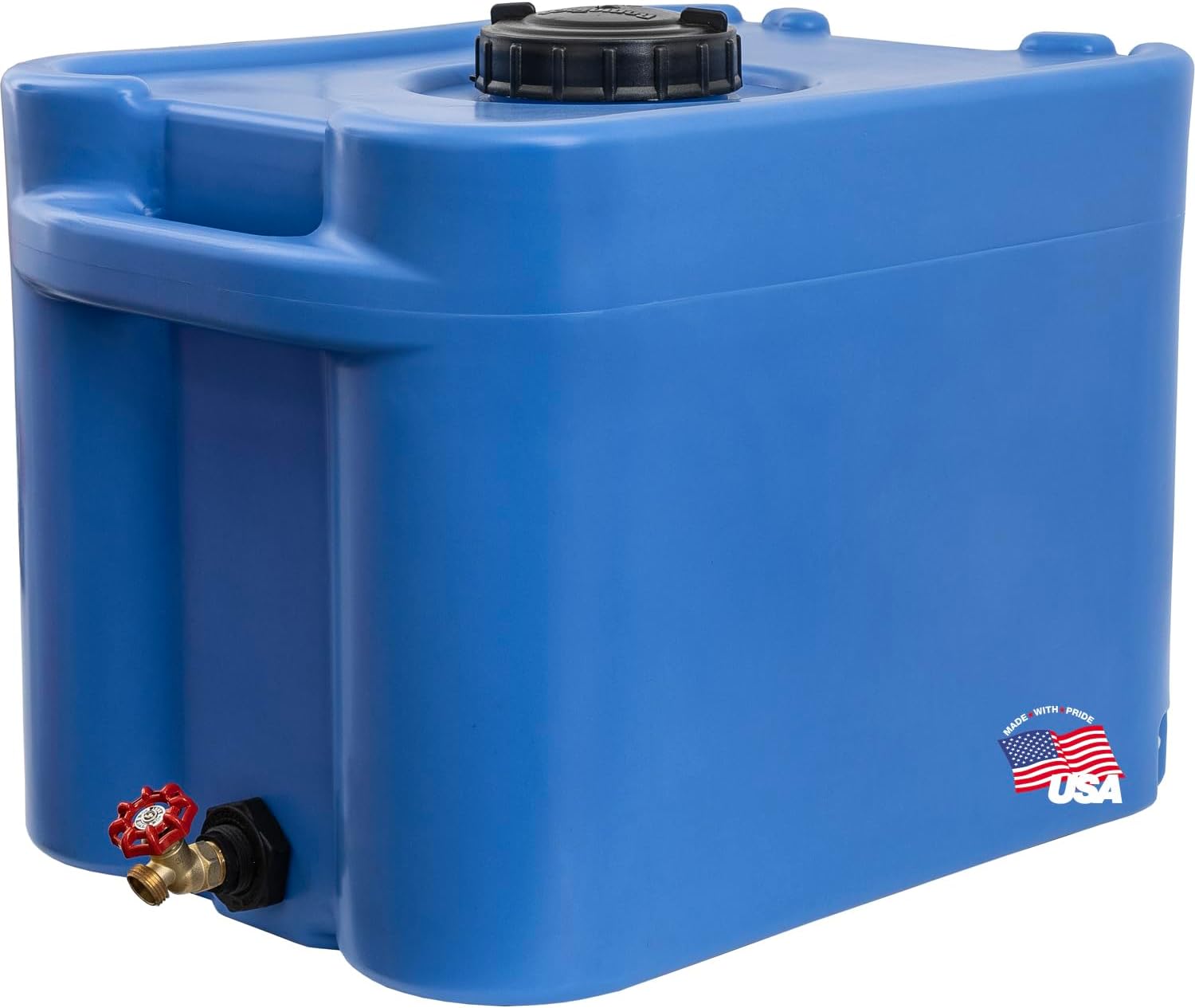
| Model | 82129393 · ASIN B0H6GMDS2H |
| Capacity | 35 US gallons |
| Full weight | ~290 lbs (35 gal × 8.34 lb/gal) |
| Material | BPA-free polyethylene |
| Color | Blue (UV-stabilized) |
| Certifications | NSF/ANSI 61 · BPA-free |
| Outlet | Brass spigot · red shutoff valve · garden hose thread |
| Fill opening | Large screw-top cap (black) |
| Mobility | Built-in tilt-and-roll wheels + integrated handles |
| Stacking | 2 units high maximum → 70 gallons same footprint |
| Max temp | 140°F contact operating temperature |
| Made in | USA — Buyers Products / RomoTech Plastics |
| Typical price | ~$90–$130 Amazon |
* Affiliate link — we may earn a commission at no cost to you.
What the RomoTech 82129393 Is
The RomoTech 82129393 is a 35-gallon blue polyethylene water storage tank designed from the ground up for portability and potable water use. It is manufactured by Buyers Products in the United States, sold under the RomoTech Plastics brand, and available on Amazon. Where most "food-grade" tanks on the market are simply made from an acceptable plastic resin, the 82129393 carries full NSF/ANSI 61 certification — which means the complete product, not just the material, has been tested for safe contact with drinking water.
The design is practical in ways that matter for actual use. The brass spigot at the base allows gravity-fed dispensing without a pump — open the red shutoff valve and water flows. The outlet is garden hose thread, which means any standard hose, drip irrigation line, or hose-thread fitting attaches directly without adapters. Built-in tilt-and-roll wheels let a single person move an empty tank. Integrated handles make two-person lifting manageable. And the stackable design means two units deliver 70 gallons of potable water storage in approximately two square feet of floor space.
NSF Approval and BPA-Free: What They Actually Mean
NSF International — formerly the National Sanitation Foundation — is the independent standards organization that certifies products for safe contact with drinking water. NSF/ANSI Standard 61 requires that certified products not leach chemicals into water at concentrations harmful to human health. For a polyethylene storage tank, this means the resin formulation, colorants, and any additives including UV stabilizers have all been tested at realistic storage conditions — not just the raw plastic material in isolation.
This distinction matters when shopping: many water storage tanks are marketed as "food-grade" or "potable water safe" based solely on the type of plastic used, without independent product-level certification. The RomoTech 82129393's NSF/ANSI 61 mark is product-level certification — the tank as it is sold and used has been independently tested.
BPA-free certification addresses a separate concern. Bisphenol A is a chemical used in some plastics associated with hormonal disruption and phased out of food-contact plastics by responsible manufacturers. The combination of NSF approval and BPA-free formulation means stored water can be kept for the months typical of emergency preparedness use without concern about chemical leaching.
UV stabilization completes the durability picture. Polyethylene without UV stabilizers degrades outdoors — becoming brittle, fading, and cracking. UV stabilizers incorporated into the resin during manufacturing protect the tank for outdoor storage, garage placement, and sun exposure without sacrificing the food-safe properties required for NSF certification.
The Design Features That Make It Practical
The brass spigot with red shutoff valve is the tank's most functionally important feature. Unlike tanks that require a pump or siphon to extract water, a bottom-mounted spigot enables gravity-fed dispensing directly into a container, bucket, or connected hose. The red handwheel provides controlled flow — not just fully open or fully closed — which matters when filling smaller containers or managing a limited supply carefully.
The garden hose thread on the spigot outlet is a deliberate compatibility choice. Any standard garden hose, drip irrigation line, or hose-thread fitting connects directly without adapters. A length of garden hose, a pressure regulator where needed, and standard drip emitters or a basic faucet fitting are all the hardware required between this tank and a working water point.
At 290 pounds full, the tank cannot be repositioned without the built-in wheels or mechanical assistance. The tilt-and-roll wheels on the base allow a single person to move it when empty or partially full. Position it in its permanent location before filling — this is the most common setup mistake.
Gravity Feed: Pressure Without a Pump
A spigot-equipped tank elevated above the point of use generates water pressure by gravity alone. The physics are straightforward: approximately 0.43 PSI per foot of elevation between the water surface and the outlet. To produce pressure useful for a basic faucet or low-flow showerhead (around 8 PSI), the water surface needs to be roughly 19 feet above the outlet — impractical for most home applications.
For practical off-grid and emergency use, however, even 3 to 5 feet of elevation produces meaningful gravity flow through a garden hose or drip emitter without a pump, power source, or pressure tank. Elevating the RomoTech on a shelf, workbench, or simple platform above a sink or wash basin delivers functional gravity-fed water access independent of the grid.
Eight Use Cases
| Use Case | Why This Tank Fits | Notes |
|---|---|---|
| Emergency preparedness | NSF-approved for potable water; 35 gallons ≈ 18–35 days for one person at FEMA guidelines | Stack two for 70-gallon household reserve. Store in basement, garage, or closet. |
| Off-grid / homestead | UV-stabilized for outdoor placement; brass spigot for direct gravity dispensing | Elevate on shelf or platform for gravity-feed to faucet or shower. |
| RV / camper supplement | Portable with handles and wheels; potable-rated; fits truck bed or tow vehicle storage | Fill at home before departure to supplement onboard tank capacity. |
| Remote jobsite water | Rugged poly; no corrosion; tilt-and-roll mobility; no piped infrastructure needed | Drinking water access for crews working without utility connections. |
| Wildfire / disaster pre-positioning | Rapid fill-and-deploy; spigot allows controlled dispensing without pump | Same principle as Chelan County's 21,000-gallon container tanks — at household scale. |
| Garden / irrigation reserve | UV-stabilized for outdoor life; 35 gallons is a substantial garden reserve | Connect hose to spigot for gravity-fed drip irrigation from an elevated position. |
| Container home / off-grid dwelling | Potable rating; stackable for higher capacity; gravity-fed from elevated position | Gravity head from roof or elevated platform for shower and sink pressure. |
| Agricultural use | Chemical-resistant poly; NSF-rated for non-flammable liquids | Verify chemical compatibility before use. Not rated for flammable liquids. |
Water Storage Best Practices
A tank certified for potable water is a vessel, not a water treatment system. The water stored is only as safe as the water that went in. These practices determine whether stored water remains safe over weeks or months:
| Practice | Why It Matters | Detail |
|---|---|---|
| Start with treated water | Residual disinfectant is the primary protection against microbial growth during storage | Municipal tap water with chlorine residual is ideal. For well or untested water: 8 drops unscented bleach per gallon (clear water) or 16 drops per gallon (cloudy) per FEMA/CDC guidelines. |
| Rotate every 6–12 months | Residual chlorine dissipates over time, reducing the disinfection buffer | Mark the fill date on the tank with a marker. Set a calendar reminder. Drain, sanitize, and refill on schedule. |
| Keep tank sealed | Prevents airborne contamination and evaporation | Screw-top cap prevents debris and airborne contamination. Keep the spigot valve closed when not dispensing. |
| Clean before first use and before refilling | Removes manufacturing residue and old water residue | 1 tablespoon unscented bleach per gallon of water. Swirl, coat interior surfaces, let sit 5 minutes, drain, rinse thoroughly. Residual bleach at these concentrations poses no health risk. |
| Store cool and dark | Heat accelerates bacterial growth and chlorine breakdown | Garage, basement, or shaded outdoor area is preferable to direct sun. UV stabilization protects the tank body but heat still degrades water quality. |
| Avoid chemical vapors | Polyethylene is somewhat permeable to organic vapors over prolonged contact | Keep away from gasoline, pesticides, solvents, and paint. Do not store potable water tanks near fuel storage. |
| Never store flammables | Rated for non-flammable liquids only | Gasoline, ethanol, and other flammable materials require tanks specifically rated for flammable liquid storage. This is not one. |
Key Takeaways
- NSF/ANSI 61 approval and BPA-free certification confirm safe sustained contact with drinking water — this is product-level certification, not just "food-grade plastic."
- Brass spigot with garden hose thread enables gravity-fed dispensing without a pump, compatible with standard hoses and drip irrigation lines.
- At 290 pounds when full, position in its final location before filling. The tilt-and-roll wheels handle an empty or partially full tank; a full tank needs wheels plus a second person.
- Two stacked units deliver 70 gallons in a two-square-foot footprint — the FEMA two-week emergency reserve for a family of four. Two-high stacking maximum; do not exceed.
- Rotate water every 6–12 months. Start with chlorinated municipal water or treat well water with unscented bleach before sealing.
- UV-stabilized blue poly is rated for outdoor storage. Store in shade or a cool garage where possible; keep away from flammable and chemical vapors.
- Gravity feed works at any elevation above the outlet. Even 3–5 feet produces useful flow for drip irrigation and basic hand-washing without a pump or power.
Water and wastewater treatment professional with 18+ years of hands-on experience. Grade IV Wastewater Certification holder. Founded TankAuthority to bring real operator knowledge to water storage decisions.